

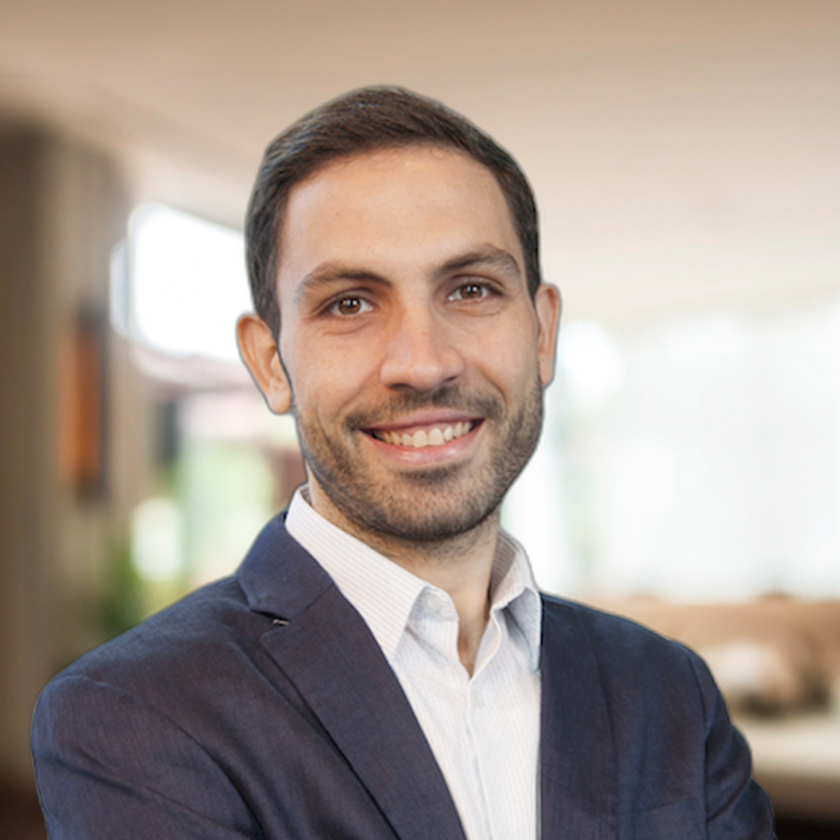
Charalambos (Harrys) Konstantinou
Associate Professor, Electrical and Computer Engineering
Computer, Electrical and Mathematical Science and Engineering Division

"Everything will be binary in the end. If it's not binary, it's not the end" almost John Lennon
Program Affiliations
Biography
Charalambos (Harrys) Konstantinou is currently an Associate Professor of Electrical and Computer Engineering (ECE) and an Affiliate Professor of Computer Science (CS) with the Computer, Electrical and Mathematical Science and Engineering Division (CEMSE), King Abdullah University of Science and Technology (KAUST), Thuwal, Saudi Arabia. He is the Principal Investigator (PI) of the Secure Next Generation Resilient Systems Laboratory (SENTRY), a co-PI of the Advanced Grid Laboratory for Cyber-Physical Energy System Applications (ANGLE) Group at KAUST, and also affiliated to the Center for Renewable Energy & Storage Technologies (CREST), KAUST. He received the M.Eng. degree in ECE from the National Technical University of Athens (NTUA), Greece, and the Ph.D. degree in Electrical Engineering from New York University (NYU), NY, USA. Before joining KAUST, he was an Assistant Professor with the Center for Advanced Power Systems (CAPS), Florida State University (FSU). His research interests include critical infrastructures security and resilience with special focus on smart grid technologies, renewable energy integration, and real-time simulation. He is a Senior Member of IEEE, and currently serving as Associate Editor of IEEE Transactions on Smart Grid (TSG) and IEEE Transactions on Power Systems (TPWRS).
Research Interests
Professor Konstantinou's research focuses on critical infrastructure security and resilience, with a specialization in smart grid technologies, renewable energy integration and real-time simulations. His SENTRY Lab investigates the cybersecurity and resilience of industrial control systems, critical power grid infrastructure and embedded systems.
The lab employs a "red team/blue team" approach, where researchers act as attackers ("red team") to test the defenses developed and deployed by the "blue team," who respond to the simulated intrusions.
Using this concept, SENTRY researchers design adaptive modeling methods, monitoring schemes and control algorithms to detect, prevent and mitigate the risk of cyberattacks, especially in critical grid infrastructures.
The group's research aims to create secure and resilient computing systems by employing computer security fundamentals and cyber-physical engineering applications.

Education Profile
PhD, New York University, 2018
MS, National Technical University of Athens, 2013
BS, National Technical University of Athens, 2013
Publications
Research Areas
- Electrical and Computer Engineering
- Computer Science